Knowledge Centre

Practical product knowledge for technical buyers.

Clear guidance on what each product is used for, which numbers matter, and what evidence buyers should request before moving to samples or bulk supply.

Renewable carbon numbers

Industrial carbon buyers normally review fixed carbon, calorific value, moisture, ash, volatile matter, sulphur, phosphorus, particle size, bulk density and fines after handling.

Energy and emissions context

For furnace or fuel applications, typical charcoal energy values sit around 28-33 MJ/kg. For carbon-storage uses, biochar assessments often translate stable carbon into estimated tCO2e retained per tonne.

Application-led selection

Activated charcoal is not selected like BBQ charcoal. Filtration buyers care about adsorption and leaching; hospitality buyers care about heat, ash and smoke; industrial buyers care about repeatable chemistry.

Qualification pathway

The professional route is usually sample review, lab test, pilot quantity, destination handling check, documentation review, then recurring supply planning.

Product comparison

How each PadriX Global charcoal route compares with old-school charcoal.

These comparisons are designed for early buyer education. They explain why professional carbon purchasing should look beyond a simple charcoal name and compare application, energy, emissions, documents and repeatability.

Green Charcoal

View product
Old-school charcoal

Conventional charcoal is often bought as a simple fuel by price and bag size, with limited batch evidence.

PadriX Global route

Green Charcoal is presented as a renewable-carbon route where energy, moisture, ash, sizing, application and documentation are reviewed together.

Energy basis

28-33 MJ/kg planning range

Emissions angle

Lower fossil-carbon reliance when used to replace coal-derived or fossil carbon inputs

Best-fit buyer

Distributors, industrial buyers and procurement teams needing a cleaner carbon category
Activated Charcoal

View product
Old-school charcoal

Old-school charcoal is unsuitable for serious filtration because it is not selected by adsorption performance.

PadriX Global route

Activated Charcoal is compared through iodine value, particle size, hardness, ash, moisture, pH and leachable contaminants.

Energy basis

Energy is not the main buying measure

Emissions angle

Value comes from filtration performance and renewable feedstock route rather than burn value

Best-fit buyer

Water treatment, air treatment, odour control and filter-media buyers

Industrial Charcoal

View product
Old-school charcoal

Traditional industrial charcoal can vary in fixed carbon, fines, moisture and density, making furnace trials harder to control.

PadriX Global route

Industrial Charcoal is positioned as process carbon where fixed carbon, 28-33 MJ/kg energy, ash, moisture and sizing are discussed before trials.

Energy basis

28-33 MJ/kg

Emissions angle

Potential fossil CO2 displacement of 2.4-3.0 t/t when replacing fossil reductants, subject to process validation

Best-fit buyer

Metallurgy, foundry, thermal process and industrial conversion buyers

Lump Charcoal

View product
Old-school charcoal

Basic lump charcoal is usually judged by price, bag weight and visible size, with less attention to destination fines.

PadriX Global route

Lump Charcoal is framed around restaurant heat, 29-33 MJ/kg energy, low moisture, ash, sizing and pallet/container planning.

Energy basis

29-33 MJ/kg

Emissions angle

Renewable biomass route can reduce dependence on fossil-derived solid fuels in commercial heating/cooking use cases

Best-fit buyer

Foodservice suppliers, restaurant wholesalers and private-label distributors

BBQ Charcoal

View product
Old-school charcoal

Commodity BBQ charcoal is often seasonal, inconsistent and weak on destination packaging or EN testing evidence.

PadriX Global route

BBQ Charcoal is compared using 28-32 MJ/kg energy, moisture, smoke, sparks, ash, labelling, pack format and EN 1860-2 route.

Energy basis

28-32 MJ/kg

Emissions angle

Renewable charcoal route with better documented packaging and compliance pathway

Best-fit buyer

Retail brands, garden trade, BBQ wholesalers and foodservice distributors

Coconut Hookah Cube

View product
Old-school charcoal

Generic shisha charcoal can vary in cube size, cracking, odour, ash and burn stability.

PadriX Global route

Coconut Hookah Cube is assessed by 25-26 mm sizing, 60-90 minute burn window, ash, moisture, odour and carton durability.

Energy basis

Heat stability and burn time matter more than MJ/kg headline

Emissions angle

Cleaner user experience is linked to low odour, low ash and controlled burn behaviour

Best-fit buyer

Shisha wholesalers, lounges, hospitality distributors and private-label brands

Wood Vinegar

View product
Old-school charcoal

Old charcoal supply usually treats liquid pyrolysis by-products as secondary or undefined.

PadriX Global route

Wood Vinegar is handled as a controlled trial product with pH, acetic acid range, dilution, packaging and use-case review.

Energy basis

Not sold as an energy product

Emissions angle

Supports biomass conversion value by using a pyrolysis co-product rather than discarding it

Best-fit buyer

Agriculture, composting, odour management and specialist process trial users

Old-school charcoal

Traditional charcoal is normally burned; it is not evaluated for stable carbon storage or soil performance.

PadriX Global route

Biochar is compared through organic carbon, H/Corg, moisture, ash, particle size, contaminants and carbon-storage potential.

Energy basis

Energy is secondary; stability and carbon content matter

Emissions angle

Indicative 2.0-2.8 tCO2e/t carbon storage planning figure, subject to certified methodology

Best-fit buyer

Agriculture, growing media, land restoration, construction research and carbon programmes

Old-school charcoal

Conventional charcoal purchasing rarely creates a structured route for pyrolysis tar or binder trials.

PadriX Global route

Bio-Tar is positioned for qualified R&D, binder, material and process evaluation with handling and safety documents first.

Energy basis

18-26 MJ/kg planning range

Emissions angle

Potential fossil binder or fuel substitution needs application-specific testing

Best-fit buyer

Industrial R&D, binder research, material trials and specialist process teams

Figures shown are indicative planning ranges for discussion. Final values must come from current product specification sheets, batch tests, safety documents and destination requirements.

Composition and emissions

How fixed carbon, volatile matter, ash and moisture change carbon performance.

Charcoal emissions are not controlled by one number. Fixed carbon improves useful carbon value; volatile matter affects smoke and early-burn emissions; ash reduces usable energy; moisture wastes heat and can increase incomplete combustion.

Fixed Carbon (%)

Higher fixed carbon normally means more useful carbon and higher energy density per kg. It is a key number for carbon replacement and stable biochar discussions.

Volatile Matter (%)

Higher volatile matter can make ignition easier, but it can also increase smoke, odour, tar vapour and unburnt hydrocarbon risk if combustion is not well controlled.

Ash (%)

Ash is non-combustible mineral residue. More ash usually means less usable energy per tonne, more disposal work and greater particulate/residue concern.

Moisture (%)

Moisture reduces delivered energy because heat is spent evaporating water. High moisture can create cooler, less complete combustion and weaker transport-adjusted carbon savings.

Composition profile

High fixed carbon, low volatile matter

Fixed carbon 78-85%, volatile matter 8-14%, ash 2-6%, moisture below 6%

Burn and process effect

Slower, steadier burn with higher useful heat per kg and less visible smoke once fully lit.

Emissions and carbon effect

Lower smoke, tar vapour and unburnt hydrocarbon risk than high-volatile material. Fossil CO2 reduction is strongest when it replaces coal, coke or fossil-derived carbon in a controlled application.

Best-fit buyer

Industrial thermal use, metallurgical trials, premium hospitality fuel and buyers needing repeatable heat.

Composition profile

Balanced commercial charcoal

Fixed carbon 70-78%, volatile matter 14-22%, ash 3-8%, moisture 6-10%

Burn and process effect

Good ignition and usable heat balance, with manageable ash and acceptable burn performance when sizing is consistent.

Emissions and carbon effect

Usually a practical lower-carbon route versus old-school fossil or poorly controlled charcoal, provided the biomass source is renewable and moisture is controlled before shipment.

Best-fit buyer

General commercial fuel, BBQ/hospitality supply and buyers balancing cost, lighting behaviour and heat output.

Composition profile

High volatile matter

Fixed carbon 60-70%, volatile matter 22-32%, ash 3-8%, moisture below 10%

Burn and process effect

Lights faster but can produce more flame, smoke and odour during early burn, especially in poor airflow.

Emissions and carbon effect

Higher risk of smoke, VOCs and incomplete-combustion emissions. It may still support carbon reduction if renewable, but it needs the right appliance, airflow and use case.

Best-fit buyer

Applications where fast ignition matters and smoke controls are acceptable.

Composition profile

High ash content

Fixed carbon 62-76%, volatile matter 10-22%, ash 8-18%, moisture below 8%

Burn and process effect

Lower net energy per kg because more of the product is non-combustible mineral matter; ash handling and residue disposal become more important.

Emissions and carbon effect

Can increase particulate and residue-management burden. Carbon benefit per tonne purchased is weaker than a cleaner high-carbon grade because less of the shipment is usable carbon.

Best-fit buyer

Only suitable where ash chemistry is acceptable and price reflects the lower usable carbon value.

Composition profile

High moisture material

Fixed carbon 65-80%, volatile matter 10-22%, ash 3-8%, moisture 12-20%+

Burn and process effect

Energy is wasted evaporating water before useful heat is delivered. Ignition is slower and the user often burns more kg to get the same work done.

Emissions and carbon effect

Higher moisture can raise CO and smoke risk through cooler combustion. It also reduces delivered energy per truckload, weakening transport-adjusted carbon savings.

Best-fit buyer

Avoid for serious energy applications unless drying, storage and delivered-weight terms are controlled.

Composition profile

Low ash, low moisture premium grade

Fixed carbon 80-88%, volatile matter 6-12%, ash 1-4%, moisture below 5%

Burn and process effect

Highest useful carbon concentration, cleaner handling, stronger heat density and less residue after use.

Emissions and carbon effect

Best directional emissions profile for fuel displacement because the buyer moves more usable renewable carbon and less water/mineral load. For biochar, stable carbon testing can support carbon-storage estimates.

Best-fit buyer

Technical buyers, export-grade fuel, soil carbon projects and higher-spec industrial conversations.

Carbon reduction should be assessed against the material being replaced. A renewable charcoal with strong fixed carbon, low ash and low moisture can reduce fossil-carbon dependence, but final CO2e claims require feedstock evidence, process data, logistics assumptions and batch analysis.

Biomass conversion flow

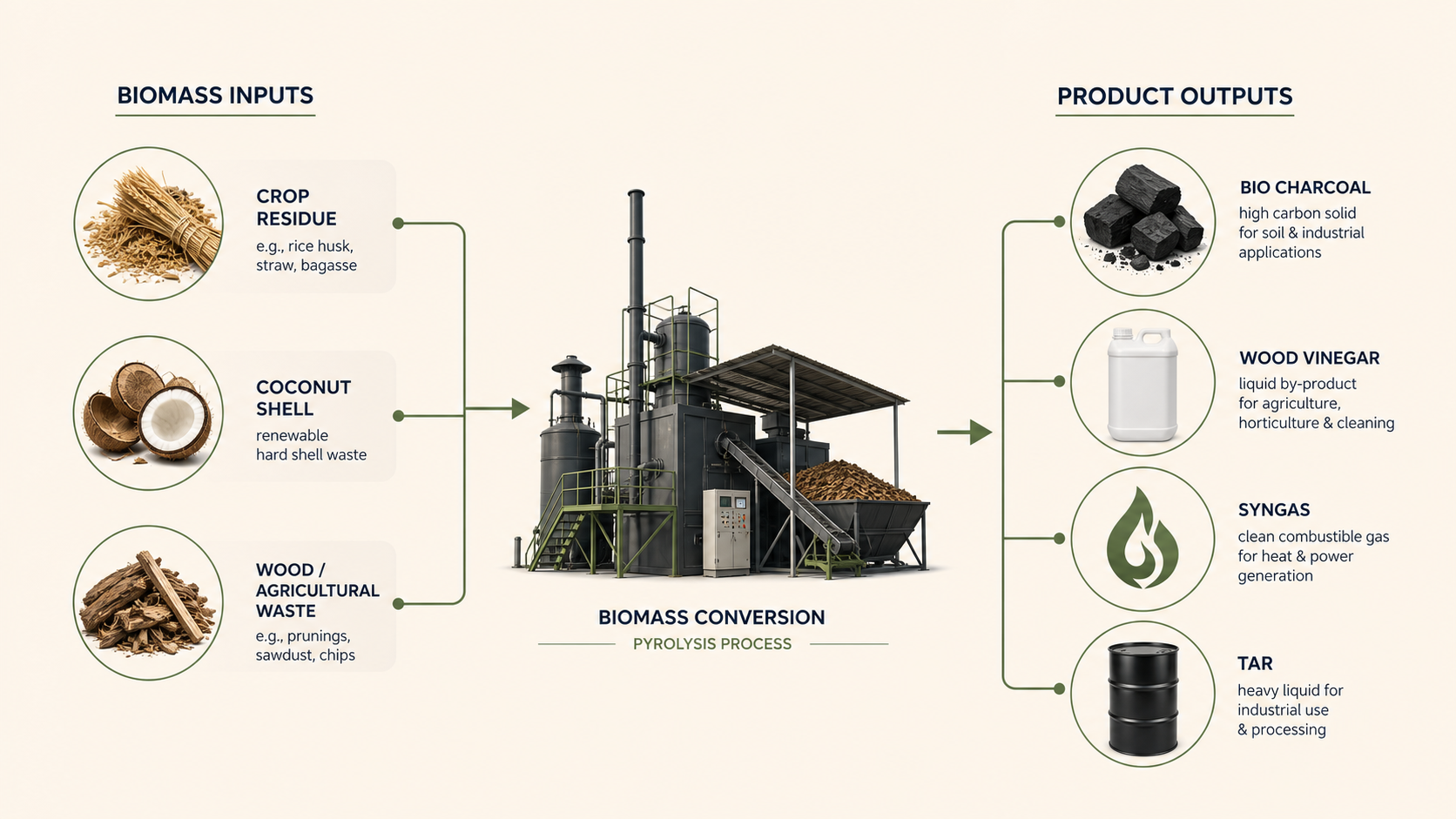
How biomass can become bio charcoal, wood vinegar, syngas and tar.

This diagram shows the broad conversion route from biomass feedstocks into useful carbon and pyrolysis outputs. For buyers, the important point is that each output needs a different technical conversation, specification and destination-use review.

Diagram showing biomass converted into bio charcoal, wood vinegar, syngas and tar
Biomass conversion diagram for buyer education. Product suitability depends on feedstock, process conditions, testing and application.
Guide

Renewable Carbon Buying Guide

Define fixed carbon, ash, moisture, sizing, energy value and delivery format before requesting pricing.

Request guidance
Guide

Commercial Solar Feasibility

A 100 kWp commercial PV system may generate roughly 85,000-95,000 kWh a year in the UK before site-specific modelling.

Request guidance
Guide

Biochar Applications

Stable biochar can support soil improvement and long-term carbon storage when feedstock, testing and application are controlled.

Request guidance
Guide

Activated Charcoal Selection

Filtration buyers normally compare iodine value, particle size, hardness, pH, ash, moisture and contaminant leaching.

Request guidance
Guide

Energy and Emissions

Renewable biocarbon is assessed through energy value, fossil-carbon displacement, feedstock traceability and batch evidence.

Request guidance